Booking toyota service dhaka sounds simple until you realise the city has three completely different service worlds, and picking the wrong one costs real money. A dealer-sold Premio and a reconditioned Axio hybrid imported from Japan don't follow the same path at all. The right choice depends on your model, your warranty, and how many kilometres you clock each month.
Toyota's maintenance schedules distinguish normal from severe operating conditions. Dhaka's stop-start traffic, long idling, short trips, dust and heat can place a vehicle under more demanding operating conditions, so the exact interval should be confirmed against the service schedule for your model and engine. For a broader explanation of how professional maintenance diagnosis should work, see our Automotive Diagnostics Explained guide. So before you book anything, you need to know which branch of the decision tree you're standing on.
Why Toyota Service in Dhaka Is a Harder Question Than It Looks
Walk through Mirpur or Uttara and count the Toyotas. Corolla Axio. Premio.
Allion. Aqua. Noah.
Harrier. Nearly all of them arrived as reconditioned Japanese domestic market (JDM) imports, not as cars sold new through a local showroom.
That single fact breaks the standard advice you'll find anywhere else. Toyota Motor Corporation built these models for Japan, with Japanese service data, Japanese part numbers, and Japanese driving conditions in mind. Dhaka is none of those things.
Then you add the local layer. Heat that sits at 35 to 40°C in summer. Humidity that never really drops.
Monsoon flooding in Mohammadpur, Dhanmondi, and low-lying Mirpur. Roads that chew through bushings and strut mounts. Traffic that turns a 10 km school run into 90 minutes of idling.
All of that pushes your car onto the severe service schedule whether you like it or not. Manufacturer specifications indicate that severe service calls for oil and filter changes every 5,000 km or six months, not the 10,000 km fantasy in the glovebox sticker.
Now stack the hybrid problem on top. Roughly half the Toyotas on Dhaka roads are hybrids, running the Hybrid Synergy Drive (HSD) system. Their traction packs run between 144V and 288V depending on model.
That is not a voltage any untrained mechanic should be poking at.
Here's the part most guides skip. The real question isn't "where's the best Toyota workshop in Dhaka." It's "which tier of workshop is correct for my specific car, right now."
That answer changes based on five things:
- Is the car still under warranty or was it dealer-sold locally?
- Is it a hybrid, a conventional petrol, or a CNG conversion?
- How many kilometres a month does it actually cover?
- Do you have documented service history or a blank book?
- What's your realistic monthly budget for maintenance?
Get those five right and the rest of the decision falls into place quickly. Get them wrong and you'll either overspend at a dealership for a job any good independent could do, or hand a high-voltage hybrid to a garage that owns one generic OBD dongle and a lot of confidence.
There's also a paperwork angle that catches people out. In Dhaka, a workshop invoice without a VAT registration and a proper pakka bill is close to worthless down the line. Insurance claims get messy.
Resale negotiations get worse. Buyers in this market know exactly what a blank service book means.
So this guide works as a routing tool, not a listicle. You'll get the three service tiers Dhaka actually offers, the five questions that decide your path, and then a branch for each situation. Read your branch, follow it, and ignore the rest.
Quick Answer: Pick Your Service Path in 30 Seconds
Toyota service in Dhaka splits into three paths. Authorised centres handle warranty and hybrid work. Independent specialists cost less and move faster.
Neighbourhood garages are cheapest and riskiest. Hybrids need a trained high-voltage technician.
Use this routing table to find your lane before you call anyone.
| Your situation | Service path |
|---|---|
| Under warranty or dealer-sold locally | Authorised network (Toyota Bangladesh Limited) |
| Out-of-warranty petrol Toyota, documented history | Vetted independent Toyota specialist |
| Any hybrid, especially pre-2015 Aqua or Prius | Hybrid-capable specialist or authorised centre only |
| Ride-hailing or fleet car doing 150+ km daily | Independent specialist on a fixed service contract |
| Old car, minor cosmetic work, tight budget | Neighbourhood garage, with clear limits |
If your car is a hybrid, skip straight to the hybrid branch. Nothing else on this page matters more than that.
The Three Service Tiers in Dhaka, Side by Side
Dhaka doesn't have "good garages" and "bad garages." It has three tiers with genuinely different capabilities, price points, and risk profiles. Knowing which tier you're walking into is half the battle.
Here's the honest comparison.
| Tier | Typical cost | Strengths | Weak points |
|---|---|---|---|
| Authorised network | Highest | Genuine Toyota Genuine Parts (TGP), Techstream diagnostics, warranty protection, documented history | Cost, queues, distance, occasional upselling |
| Independent Toyota specialist | Mid | Hybrid-capable, faster, honest diagnosis, strong parts sourcing | Quality varies wildly, you have to vet them |
| Neighbourhood garage | Lowest | Cheap, nearby, quick turnaround | No high-voltage training, high counterfeit risk, no proper invoice |
Authorised Network: Navana Limited and Toyota Bangladesh Limited
Toyota Bangladesh Limited is now the sole official distributor of Toyota vehicles, genuine parts, and aftersales service in the country, following the conclusion of Toyota’s long-standing partnership with Navana Limited in September 2025. Owners now access authorised service through Toyota’s official “T-Center” workshops: Continental Works in Dhaka and Carboy Private Limited in Chattogram. If your service book or paperwork still references Navana, confirm with the current network how your history transfers.
What you get here is predictability. Toyota Techstream and GTS+ diagnostic platforms. Genuine parts counter access.
Service records that actually mean something at resale. Trained technicians who have seen your model before.
What you pay for it is roughly 40 to 80 percent more in labour than an independent, plus longer waits. For a warranty car, that premium is worth every taka. For a 2012 Axio with 180,000 km and no warranty left, you're mostly buying comfort.
People assume dealerships never upsell. In our review of owner reports from Dhaka forums and community groups, throttle body cleaning and injector flush recommendations on low-mileage cars come up often enough to mention. Ask for the diagnostic evidence before approving anything beyond the scheduled service.
Independent Toyota Specialists
This is where most experienced Dhaka Toyota owners end up, and for good reason. The strong independents sit in Tejgaon, Kazipara, Shewrapara, Uttara, and the Banani, Gulshan belt. Many are ex-dealer technicians who took their Techstream access, their parts relationships, and their knowledge with them.
A good independent will show you the fault codes before clearing them. They'll let you see the old part. They'll tell you when a job doesn't need doing yet.
And they'll source Toyota Genuine Parts or known OEM-quality equivalents from Denso, Aisin, NGK, KYB, Advics, NSK, NTN, and Koyo.
The catch is vetting. There's no certification body for independent Toyota workshops in Bangladesh, so quality is entirely down to who runs the place. Look for a workshop that owns a J2534 Mini-VCI cable or genuine Techstream setup.
Ask specifically how they handle hybrid high-voltage work. The answer tells you everything.
Neighbourhood Garages and the Real Cost of Cheap
The neighbourhood "mistri" garage is a Dhaka institution. Cheap, fast, two streets away, and often genuinely skilled at mechanical basics like brakes, suspension, and oil changes on older petrol cars.
For a 2005 Corolla with no electronics worth diagnosing, that's a reasonable call. For anything hybrid, anything with a warranty, and anything with a modern ECU, it's a gamble you probably lose.
Three specific risks stand out:
- Counterfeit consumables. Fake Toyota oil filters, spark plugs, and brake pads are openly sold in Gulistan and parts of Kazipara. A cheap oil change with a fake filter can cost you an engine.
- No high-voltage procedure. Opening a hybrid pack without removing the service plug and waiting the specified discharge time (typically around 10 minutes) is a serious electrocution risk.
- No documentation. No VAT invoice means no insurance paper trail and a weaker resale position.
The honest framing is this. Cheap is fine until it isn't. One hybrid inverter failure caused by a botched repair wipes out five years of savings from using a cheap garage.
Start Here: The Five Questions That Decide Everything
Before you call a single workshop, answer these five. They route you into the correct branch of this guide, and they'll save you from booking the wrong tier.
1. Is the car still under warranty or was it bought new locally?
If yes, you're in Branch 1 and you should stay inside the authorised network for anything warranty-relevant. Servicing outside it can void coverage, and the terms are model and year specific.
If the car is a reconditioned import with no local warranty, move to Branch 2, 3, or 4 depending on what's under the bonnet.
2. Is it a hybrid?
Any Toyota with Hybrid Synergy Drive needs a workshop with high-voltage training, insulated tooling, and hybrid diagnostic capability. This is non-negotiable, and it overrides every budget consideration.
Hybrid models common in Dhaka include the Aqua (NHP10), Prius (ZVW30, ZVW50, ZVW51), Axio Hybrid, Sienta, and Noah and Voxy hybrids. If yours is one of these, go to Branch 3.
3. How many kilometres a month does it cover?
Under 1,000 km a month with mostly short trips still counts as severe service. Dhaka's stop-start traffic and long idling periods do the damage, not distance.
Above 2,000 km a month, you're in fleet territory. That's Branch 4, and you want a service contract with fixed pricing and predictable turnaround.
4. Do you have service history?
A documented service book with matching mileage changes what a workshop can safely assume. No history means you should budget for a baseline service: all fluids, all filters, brake inspection, and a hybrid health check if applicable.
5. What's your realistic monthly maintenance budget?
Be honest here. A hybrid Toyota at a good independent runs roughly BDT 4,000 to 7,000 for a standard service. At the authorised network, expect BDT 6,000 to 12,000.
Add tyre, battery, and suspension wear as the car ages.
If your budget can't stretch to a hybrid-capable workshop, that's a reason to reconsider owning a hybrid, not a reason to gamble on one.
Once you've answered all five, jump directly to your branch.
Branch 1: Your Toyota Is Under Warranty or Was Dealer-Sold
This branch is the simplest in the whole guide. Stay inside the authorised network for anything that could possibly fall under warranty, and keep every document.
What Toyota Warranty Typically Covers
Manufacturer warranty terms vary by model and model year, so confirm yours in writing with Toyota Bangladesh Limited or its authorised T-Center workshops. As a general pattern, Toyota's global new-vehicle warranty covers repairs for defects in materials or workmanship for a set period or mileage, whichever comes first.
Hybrid-specific coverage is the part people miss. Toyota has historically offered extended coverage on hybrid battery packs and hybrid system components well beyond the standard new-car term in many markets. Whether that applies to your Bangladesh-registered vehicle depends entirely on how it was sold and what documentation you hold.
Do not assume. Ask for the warranty statement in writing, and ask specifically about the hybrid battery.
What Voids Coverage in Practice
Warranty claims get rejected for predictable reasons, and most of them are avoidable.
- Servicing outside the authorised network during the warranty period, especially for engine, transmission, or hybrid system work
- Non-genuine or incorrect-spec parts fitted to warrantied components
- Missed service intervals, with no record of the service having happened
- Accident damage repaired poorly, which shows up later as corrosion or alignment faults
- Flood damage, which is almost never covered and is easy for inspectors to spot
- Unauthorised CNG or LPG conversion, which affects engine and fuel system coverage
The missed-interval one catches the most people. If your car was due at 5,000 km and you show up at 9,000 km, you've given the distributor a legitimate reason to push back.
How to Keep Your Paper Trail Clean
Keep a physical folder. Every job card, every invoice, every parts list. Take a photo of the odometer at each service.
The reason is resale. In the Dhaka used market, a complete authorised service history adds measurable value to a Toyota. Buyers know the difference between a car with a stamped book and a car with a story.
For regulatory paperwork, BRTA handles registration, tax token, fitness certificates, and the emission test certificate required for fitness renewal. Keep those current. A lapsed tax token makes an otherwise clean car harder to sell and can create problems if you're stopped.
When You Can Safely Step Outside the Network
There are two situations where leaving the authorised network won't hurt you.
First, non-warranty items. Tyres, wipers, batteries, and cosmetic work have nothing to do with your warranty coverage, so you can source them anywhere reputable. Many Dhaka owners use Rahimafrooz batteries (Volta, Globatt) or Lucas, and Bridgestone, Dunlop, Yokohama, or Hankook tyres, without touching their warranty.
Second, consumables you can document. If you must get an oil change elsewhere, use Toyota Genuine Motor Oil in the correct grade, keep the receipt, and record the mileage. For hybrid and modern engines that usually means 0W-20, though you should confirm the exact grade in your owner's manual.
For anything touching the engine internals, the transmission, the e-CVT transaxle, or the hybrid system, stay inside. The cost difference isn't worth the exposure while you still have coverage.
Branch 2: Out-of-Warranty Petrol Toyota (Axio, Premio, Allion, Noah, Harrier)
If your Toyota is a conventional petrol model past its warranty, you've got the widest set of good options and the biggest chance to save real money. This is the branch where a properly vetted independent specialist pays for itself several times a year.
The models in question are mostly 1.5L and 1.8L four-cylinder JDM imports. Think the Corolla Axio (NZE161), Corolla Fielder, Premio (NZT260), Allion, Vitz, Noah (ZRR80), and Harrier (ZSU60). All of them are chain-driven, not belt-driven, which removes one common maintenance item.
What Actually Needs Doing, and When
Manufacturer specifications indicate a 10,000 km or 12-month interval for normal service. Dhaka traffic doesn't qualify as normal, so you're on 5,000 km or six months. Here's the full picture for a petrol Toyota in this city.
| Item | Dhaka interval | Notes |
|---|---|---|
| Engine oil and filter | 5,000 km or 6 months | Full synthetic, 0W-20 for most; confirm in your manual |
| Engine air filter | 10,000 to 20,000 km | Dust and construction grit shorten this fast |
| Cabin (AC) filter | 10,000 km | Short trips in traffic clog these quickly |
| Brake fluid | 24 months | Regardless of mileage, it absorbs moisture |
| Coolant (Super Long Life Coolant) | Per manual, typically long interval | Pink SLLC, do not mix with green coolant |
| Spark plugs (iridium) | 80,000 to 100,000 km | Denso or NGK, gap-critical |
| CVT or ATF fluid | 40,000 to 60,000 km | ATF WS or CVT Fluid TC, model-specific |
| Fuel filter | 60,000 to 80,000 km | Worsens with variable fuel quality |
| Timing chain | Inspect at high mileage | Usually a chain, no scheduled replacement |
Note the transmission fluid line carefully. Toyota CVT Fluid TC and Toyota ATF WS are not interchangeable, and neither is a generic "universal" fluid. Fitting the wrong one in a Super CVT-i unit is one of the most expensive mistakes an independent garage can make.
The Dhaka-Specific Wear List
Beyond scheduled fluids, these are the parts Dhaka roads eat fastest on a petrol Toyota. If the engine has variable valve timing faults, our Toyota VVT diagnostic guide covers the relevant symptoms and DTCs. For cam/crank correlation faults, see our Toyota P0016 guide.
- Front lower control arm bushings and strut mounts. Potholes and speed breakers destroy these by 80,000 to 120,000 km.
- Stabiliser links and tie rod ends. Cheap parts, big difference in steering feel.
- Shock absorbers and mounts. KYB is the common OEM-quality choice.
- Brake pads and discs. Stop-start traffic wears pads faster than highway driving.
- 12V battery. Dhaka heat typically kills these in 1.5 to 2.5 years, not the four years you'd get in a cooler climate.
- AC condenser and compressor. Dust blocks the condenser, and high ambient heat works the compressor hard.
- Wheel bearings. Monsoon water ingress accelerates corrosion.
If you're hearing a clunk over speed breakers, it's usually bushings or stabiliser links. If the steering feels loose at speed, check tie rod ends and ball joints before anything else.
How to Vet an Independent Specialist
There's no certification body for independent Toyota workshops in Bangladesh. That means the vetting is on you, and it's worth doing properly.
Ask these questions before handing over the keys:
- Do you have a genuine Toyota Techstream or GTS+ setup, or a J2534 Mini-VCI cable?
- Can you show me the fault codes before and after the repair?
- What oil grade do you use for this model, and can I see the container?
- Do you source Toyota Genuine Parts, and can you show me the packaging before fitting?
- Will you give me a VAT invoice?
- Can I see the old part after the job?
A workshop that answers all six cleanly is worth a long relationship. One that deflects on two or more is a risk you don't need.
Should You Consider CNG Conversion?
Older petrol Toyotas in Dhaka are often converted to CNG, and BRTA-approved conversion through an RPGCL-licensed workshop is legal. There's a real running-cost argument if you cover a lot of kilometres.
But CNG conversion has consequences. Older engines can suffer valve seat recession, and driveability and cold-start behaviour often get worse. It also complicates later diagnostics, since the ECU now sees two fuel systems.
If your car is under any remaining powertrain coverage, skip it. If it's a 15-year-old Corolla with no coverage and a 200 km daily commute, the maths can work out. Just budget for the trade-offs.
Branch 3: Hybrid Toyota (Aqua, Prius, Axio Hybrid, Sienta, Harrier Hybrid)
Hybrids need their own branch because the risk profile is completely different. This isn't about getting a slightly worse service. It's about a system that can seriously injure someone who doesn't know the procedure.
The hybrid Toyotas common in Dhaka run Hybrid Synergy Drive. That covers the Aqua (NHP10), Prius (ZVW30, ZVW50, ZVW51), Axio Hybrid (NKE165), Sienta, Noah and Voxy hybrids (ZWR80), and Harrier Hybrid (ZSU65).
Why a Normal Garage Shouldn't Touch an HV System
Because the traction system runs at high voltage, and the safety procedure is not optional. Pack voltage sits between roughly 144V and 288V depending on model, carried through orange cables that are clearly marked.
The correct procedure involves removing the high-voltage service plug, then waiting the manufacturer-specified discharge time before touching inverter or pack connectors. Toyota's own service documentation puts that wait at around 10 minutes. Skip it and you're working on a live circuit.
Insulated gloves, no jewellery, and a one-hand working rule all apply. So does tool discipline. A dropped wrench across the wrong terminals is a flash burn at best.
If a workshop can't explain the service plug procedure to you in plain language, don't let them near your car. That's the whole test.
Hybrid Battery Cooling Fan Filter: The 20-Minute Job That Saves a Pack
The hybrid battery sits behind the rear seat on most of these models, cooled by a dedicated fan that pulls cabin air across the modules. That air carries dust, and Dhaka has plenty of it.
The fan intake filter clogs. Airflow drops. The pack runs hot.
Heat is the single biggest killer of a nickel-metal hydride pack, and Dhaka's 35 to 40°C summers give you no margin.
Cleaning or replacing this filter every 10,000 to 20,000 km costs somewhere in the range of BDT 1,000 to 2,500 at a good specialist. It takes about 20 minutes. Owners who skip it are the ones shopping for a replacement pack years early.
This is the highest-return maintenance item on any hybrid Toyota in Dhaka. If your workshop isn't checking it as standard, ask why.
Reading the Warning Signs Before They Become Codes
Hybrid faults usually announce themselves before a dashboard light shows up. Watch for these.
- Falling fuel economy, from 20 km/L down to 13 or 14 km/L in the same driving
- The engine running far more than it used to
- Reduced acceleration from a standstill
- Frequent battery level swings on the dash display
- A persistent slight smell from the rear seat area
When a scanner does get plugged in, the codes that matter most are P0A80 for pack deterioration, P0A7F for module voltage issues, and P3000 for hybrid battery system faults. A hybrid-capable workshop will pull cell block voltages and give you a health report, not just a code read. For a deeper look at this specific warning, see our Toyota hybrid battery warning light diagnosis guide.
Reconditioned vs Module Repair vs New OEM Pack
This is the decision that costs the most money, so get it right.
| Option | Typical Dhaka cost | Lifespan expectation | Best for |
|---|---|---|---|
| New OEM pack | BDT 3 to 5 lakh | Longest, closest to original | Cars you plan to keep 5+ years |
| Japan-used or reconditioned full pack | BDT 45,000 to 150,000 | Variable, often 1 to 3 years | Budget-conscious daily drivers |
| Module or cell block repair | Lowest of the three | Depends on health of the rest of the pack | Packs with one or two weak modules |
A reconditioned pack is only as good as the shop selling it. Ask for a written voltage report on the pack before installation. Ask about warranty terms in writing, and how many months they cover.
Module-level repair works when the rest of the pack tests healthy. If three or four modules are already drifting, you're paying now and paying again soon.
The Smaller Hybrid Details That Get Missed
The hybrid system has two coolant loops, and they are not the same fluid. There's the normal engine coolant, and there's the separate inverter coolant loop. Both need servicing, but on different schedules and with different procedures.
The 12V auxiliary battery matters more on a hybrid than people expect. It powers the computers that wake the high-voltage system up. A weak 12V battery produces symptoms that look like major hybrid failure. A proper car diagnostic scan in Dhaka can help distinguish a low-voltage problem from a genuine hybrid-system fault.
Regenerative braking means brake pads on hybrids typically last considerably longer than on a petrol car. That doesn't make them immortal, and Dhaka traffic still wears them. Get them measured at every service.
Branch 4: High-Mileage, Fleet, and Ride-Hailing Toyotas
If you're running a Pathao, Uber, or Shohoz car, or managing a corporate pool of Premios, Allions, Noahs, and Hiaces, this branch is built for you. The economics change completely when downtime costs money every hour.
A ride-hailing Toyota in Dhaka commonly covers 100 to 200 km a day. That's 3,000 to 6,000 km a month, which puts you on the severe service schedule permanently and then some.
Move to a Fixed Service Contract
At that mileage, spot pricing is a waste. Negotiate a monthly or per-service contract with a vetted independent specialist that covers oil, filters, brake inspection, tyre rotation, and a diagnostics scan.
The value isn't the discount. It's the predictability. You know the cost per month, you know the turnaround, and you stop making emergency decisions at 9pm when something starts rattling.
For fleets, ask about a retainer arrangement with priority booking. Two or three cars off the road simultaneously during peak season is a real revenue problem.
Preventive Replacement Beats Reactive Repair
At fleet mileage, replacing a part before it fails is almost always cheaper than fixing the fallout. These are the items worth running on a schedule rather than waiting for symptoms.
- Brake pads. Measure at every service. Replace at 1.0 to 1.5 mm minimum thickness.
- 12V batteries. Test at 18 months and replace proactively in this climate.
- Coolant hoses and belts. Heat and age degrade rubber faster than mileage suggests.
- CVT or ATF fluid. Halve the normal interval at fleet mileage.
- Water pump. On high-mileage engines, a seized pump means an overheating event and possibly a head gasket.
- Hybrid cooling fan filter. Every 10,000 km, no exceptions.
- Tyres. Rotate every 5,000 to 8,000 km and check alignment after any pothole impact.
Tracking, Paperwork, and Corporate Requirements
Corporate and bank fleets in Dhaka need documentation for reimbursement and audit. That means a VAT-registered workshop, a proper pakka bill, and a job card that lists parts by number.
Set up a simple per-vehicle log from day one. Date, odometer, work done, parts fitted, cost, next due. It takes five minutes and it saves hours later.
It also protects resale value. A fleet Toyota with a complete, consistent maintenance log sells faster and for more than the same car with a shoebox of loose receipts.
Commercial Hiace Considerations
The locally assembled Hiace and imported units are workhorses with different priorities. Downtime is the enemy. Fluid condition, brake wear, and cooling system health are the three things that take a Hiace off the road.
Keep a spare 12V battery and a set of brake pads in the yard. The cost of holding them is far lower than a day of lost revenue. And check the rear leaf springs and shackle bushings regularly, since commercial loads punish them.
Branch 5: Buying Used: The Pre-Purchase Inspection Path
If you're buying a used Toyota in Dhaka, a professional pre-purchase inspection (PPI) can help identify mechanical, electrical, structural and hybrid-system issues before you pay. See our used-car pre-purchase checklist for a broader inspection framework.
Why This Market Needs a PPI More Than Most
The Dhaka reconditioned import market has three well-documented problems. Odometer tampering is common and hard to prove after purchase. Flood-damaged cars get cleaned up and resold.
Accident-repaired cars with structural work pass as clean.
There's also the fake auction sheet problem. A photocopied JEVIC or USS sheet looks convincing, and most buyers can't tell a genuine one from a reproduction.
The National Board of Revenue import policy shapes what's legal to bring in, including age limits and duty bands by engine capacity. A car's paperwork needs to match its actual import history. That's a separate check from the mechanical one.
What a Proper PPI Covers
A serious inspection isn't a five-minute look under the bonnet. Insist on a workshop you chose, not one the seller recommended.
- Odometer verification. Cross-check against auction sheet, service stickers, and wear items. Pedal rubbers, steering wheel finish, seat bolsters, and the gear knob tell the real story.
- Chassis and structural check. Look for weld marks, overspray, and panel gaps that don't match.
- Paint thickness measurement. Thick readings mean filler.
- Compression test on petrol engines, plus a leak-down if readings are uneven.
- Hybrid health check with cell block voltage readings and a battery report if it's a hybrid.
- OBD history scan. Stored codes and readiness monitors reveal recently cleared faults.
- Underbody inspection for rust, flood residue, and impact damage.
- Brake disc lip measurement. A pronounced lip contradicts a low claimed mileage.
- Tyre date codes. Four tyres with mismatched dates and brands suggests replacement under duress.
- Glass date codes. Mismatched glass hints at accident repair.
- Suspension and steering check on a lift, not in a car park.
- Full fluid check. Colour and smell tell you about maintenance habits quickly.
The Paperwork You Must Verify
Mechanical condition is only half the deal. In Dhaka, paperwork problems can make a perfectly good car unsellable.
- BRTA Blue Book with matching chassis and engine numbers
- Current tax token and any arrears
- Fitness certificate and emission test certificate
- Import documentation aligned with the current NBR policy
- Ownership chain with no disputes or outstanding loans
- Service records consistent with the odometer
Walk away if the chassis number doesn't match the Blue Book. No discount makes that worth it.
Red Flags That Should End the Conversation
Some issues are negotiable. These aren't.
- Seller refuses an independent inspection
- Odometer reads suspiciously low for a 10-year-old import
- Fresh undercoating on a car that shouldn't need it
- Mismatched paint on one side
- Engine bay cleaned to a suspicious shine
- Watermarks behind trim panels or rust on seat rails
- Hybrid pack health report refused or unavailable
- No BRTA papers available to view
If two or more of those show up, stop. There are plenty of clean cars in this market.
What a Proper Dhaka Service Actually Looks Like, Step by Step
Knowing the sequence protects you from being rushed, upcharged, or talked past. Here's how a well-run service should flow, from the first phone call to the final invoice.
Booking, Job Card, and Diagnosis
Book by phone, hotline, WhatsApp, or walk-in. Expect a 1 to 3 hour turnaround for a standard service at a good independent, longer at a dealership.
First thing on arrival is the odometer check. Get it written on the job card. That single number protects both you and the workshop if anything is disputed later.
Then comes the job card itself. It should list your reported symptoms, the agreed work, and a written estimate. Never approve additional work verbally over the phone without a price.
Diagnosis comes next. On a hybrid, that means Techstream or GTS+ pulling cell block voltages and hybrid codes. On a petrol Toyota, it's a full code scan plus a readiness monitor check.
Ask to see the screen.
Only after diagnosis should you approve the repair. Any workshop that quotes before scanning is guessing.
The Severe-Service Schedule Dhaka Traffic Forces On You
Manufacturer specifications draw a clear line between normal and severe service. Severe service covers heavy idling, short trips, stop-start traffic, dusty conditions, and high ambient heat. Dhaka gives you all five.
That's why the 5,000 km or six-month interval applies to almost every car in this city. It isn't dealer upselling. It's what the schedule actually says for these conditions.
Here's the practical version.
| Condition | Interval |
|---|---|
| Mostly highway, long runs, low dust | 10,000 km or 12 months |
| Dhaka city driving, short trips, heavy idling | 5,000 km or 6 months |
| Ride-hailing or fleet mileage | 5,000 km, often sooner in practice |
| Hybrid fan filter clean | Every 10,000 to 20,000 km |
| Brake fluid | Every 24 months |
| 12V battery test | Every 6 months in this climate |
If you're driving 20 minutes each way to work in traffic, you're on the bottom row. There's no version of Dhaka driving that qualifies as normal service.
Genuine Part Verification Before Anything Gets Fitted
This step is where money gets quietly lost, so slow the process down. Ask to see the packaging before the part goes on the car.
Toyota Genuine Parts use a hologram and consistent, high-quality packaging print. Blurry text, thin cardboard, and a missing hologram are immediate warning signs. Cross-check the part number against your model's electronic parts catalogue if you can.
Weight and finish give fakes away faster than anything else. A counterfeit oil filter feels light and the internal anti-drain-back valve is often absent. Fake iridium spark plugs have visibly rough electrodes.
For a visual reference, the image below shows Toyota Genuine Parts packaging as it should look. If what you're handed looks meaningfully different, ask questions before it goes anywhere near your engine.
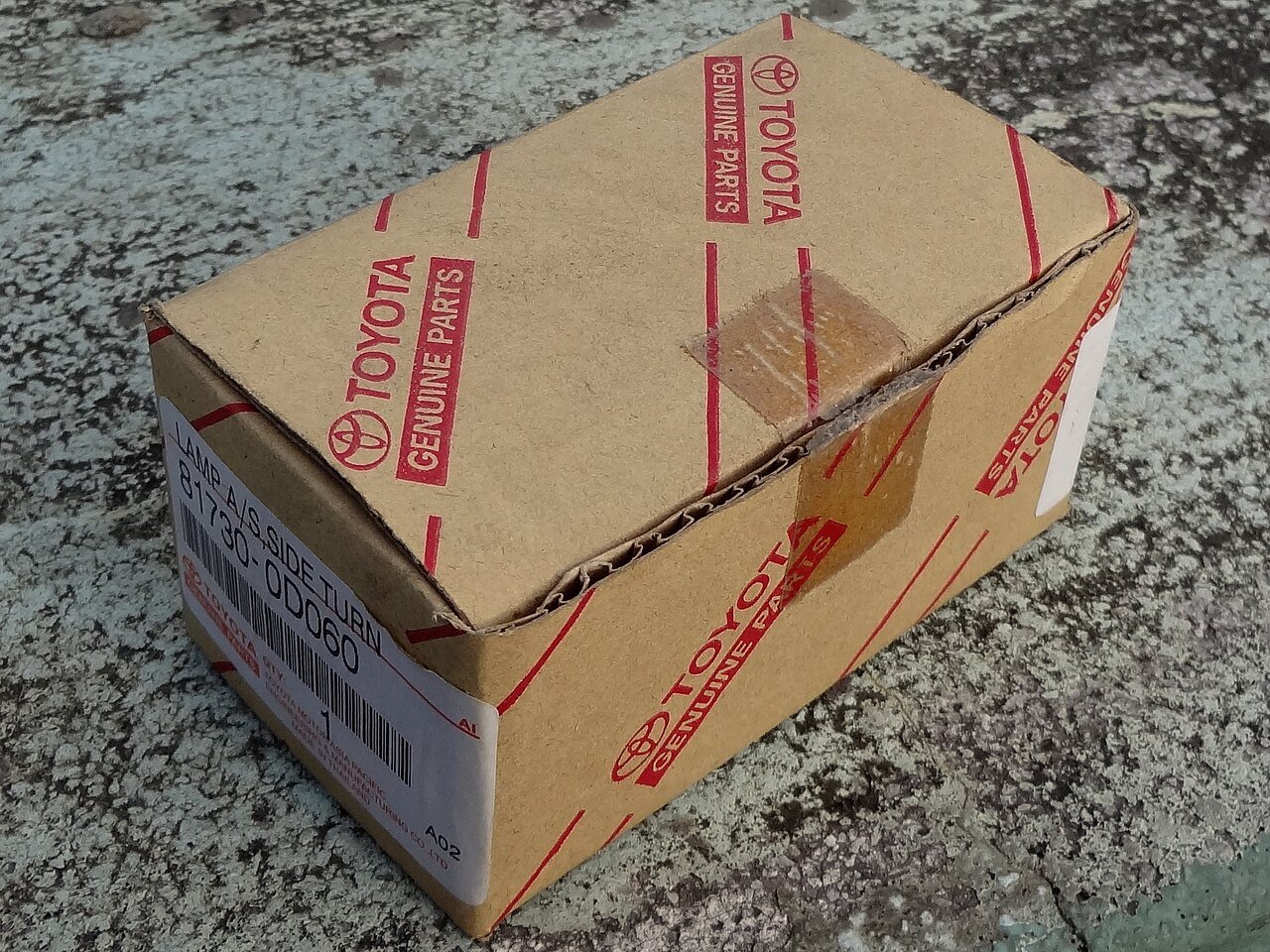
Image source: Wikimedia Commons / Solomon203 (CC BY-SA)
After the job, work through this closing checklist.
- Ask for the old parts back, or at least to see them
- Confirm the invoice lists part numbers, not just descriptions
- Check the odometer reading on the invoice matches your car
- Get the next service interval written down
- Confirm whether you received a VAT invoice
- Save the job card with your service records
Then road test before you leave the area. If a new noise appeared during the work, it's far easier to resolve while you're still parked outside.
One last note on fluids. Toyota publishes its recommended grades and intervals in the owner's manual for each model, and that document beats any general advice, including this one. If your manual says 0W-16 and a workshop insists on 10W-40 because "that's what we always use," find another workshop.
What It Really Costs: Dhaka Price Ranges Worth Planning Around
Every figure below is an indicative Dhaka market range as of 2026, gathered from published workshop rate cards, owner-reported invoices, and parts counter pricing. Treat them as planning numbers, not quotes. Exchange rates and import duty cycles move parts pricing more than anything else in this city.
Labour is the smaller half of your bill. Parts and fluids are where the money actually goes.
| Service item | Independent specialist | Authorised centre |
|---|---|---|
| Basic service (oil, filter, inspection) | BDT 3,500 to 7,000 | BDT 6,000 to 12,000 |
| Engine oil capacity, 1.5L to 1.8L engines | 3.5 to 4.5 litres with filter | Same |
| AC service (recover, leak test, recharge) | BDT 4,000 to 9,000 | BDT 7,000 to 14,000 |
| Wheel alignment (3D) | BDT 1,000 to 2,500 | BDT 2,000 to 4,000 |
| Brake pad set, front or rear | BDT 3,000 to 9,000 | BDT 6,000 to 14,000 |
| 12V battery replacement | BDT 8,000 to 15,000 | BDT 12,000 to 20,000 |
| Hybrid fan filter clean | BDT 1,000 to 2,500 | BDT 2,000 to 4,000 |
| Pre-purchase inspection | BDT 3,000 to 8,000 | BDT 6,000 to 12,000 |
Hybrid components are the outlier, and they deserve their own table.
| Hybrid item | Typical Dhaka cost | Notes |
|---|---|---|
| Used or reconditioned full pack | BDT 45,000 to 150,000 | Ask for a written voltage report first |
| New OEM pack | BDT 3 to 5 lakh | Model-dependent, often ordered to spec |
| Module or cell block repair | Lowest of the three | Only viable if the rest of the pack tests healthy |
| Hybrid diagnostic scan | BDT 1,000 to 3,000 | Should include cell block readings |
| Inverter coolant service | BDT 2,000 to 5,000 | Separate loop from engine coolant |
Timelines matter as much as price when you're without a car.
| Job | Expect this turnaround |
|---|---|
| Routine service | 1 to 3 hours |
| Hybrid battery swap | 4 to 8 hours |
| Engine overhaul | 5 to 10 days |
| Parts from Japan, air freight | 1 to 2 weeks |
| Parts from Japan, sea freight | 3 to 5 weeks |
That parts timeline is the real hidden cost in Dhaka. JDM-only trim pieces, hybrid-specific sensors, and certain body panels simply aren't on a shelf in Kazipara. If your car is off the road during the wait, that's your true expense.
Where Owners Overspend and Where They Under-Spend
The pattern in owner-reported invoices is fairly consistent. People overspend on fluids they don't need and under-spend on the parts that actually prevent failure.
Over-spending usually looks like this:
- Engine flush additives on a healthy engine with regular oil changes
- Premium oil grades above what the manual specifies, for no measured benefit
- Cosmetic add-ons before mechanical baseline work
- Repeat AC recharges without ever fixing the leak
Under-spending looks like this:
- Skipping the hybrid fan filter clean
- Stretching oil changes past 5,000 km because the car "feels fine"
- Using a cheap 12V battery in a hybrid, where the computer load is higher
- Ignoring bushing and mount wear until it damages tyres and alignment
The cheap 12V battery point catches people repeatedly. A hybrid's high-voltage system wakes up through its 12V computer network. A weak auxiliary battery produces symptoms owners misread as hybrid failure.
Genuine vs Counterfeit: Protecting Yourself in Kazipara and Gulistan
Counterfeit Toyota parts are the single biggest quiet risk in the Dhaka market. Fake oil filters, spark plugs, and brake pads circulate openly in open spare parts markets. They look close enough to fool a buyer in a hurry.
The damage isn't instant. It shows up months later as engine wear, poor braking, or a failed sensor, and by then you can't prove where the part came from.
What Gets Faked Most Often
Some components get copied far more than others, usually because they're high-volume and easy to reproduce.
- Engine oil filters
- Iridium and platinum spark plugs
- Brake pads and discs
- Air and cabin filters
- ATF and CVT fluid in reused branded bottles
- Timing chain tensioners
- Oxygen sensors and MAF sensors
- Shock absorbers and suspension links
Fluids deserve special warning. Refilled branded bottles with the wrong fluid inside are common, and the seal quality is usually the giveaway. If the cap seal is missing or the print on the label looks slightly off, walk away.
How to Tell Genuine Toyota Genuine Parts From Fakes
Toyota Genuine Parts carry a hologram and consistent packaging print quality. A genuine Toyota Genuine Parts paper box has crisp, even printing, a proper hologram, and correct part numbering on the label. Where it was made is less relevant than whether it came through the official supply chain.
Work through this check before anything gets fitted.
- Check the hologram. Genuine holograms shift colour and have fine detail. Copies look flat and slightly washed out.
- Check print quality. Fuzzy edges, mismatched fonts, or uneven ink density are immediate red flags.
- Check the part number against your model. Every Toyota part number tells you which model family it fits.
- Check weight and feel. Fake oil filters feel noticeably lighter. Fake brake pads have coarser friction material texture.
- Check the internal valve on oil filters. Many counterfeits omit the anti-drain-back valve entirely.
- Check spark plug electrodes. Genuine iridium tips are fine and precisely formed. Fakes look rough and inconsistent.
- Read the packaging in daylight, not under a workshop bulb. Fluorescent light hides print defects.
If you're ever unsure, buy from the authorised parts counter instead of an open market stall. You'll pay more. You won't be gambling with your engine.
Why the Counterfeit Problem Persists
Counterfeits survive in this market for three connected reasons. Price sensitivity is real, and genuine Toyota parts cost meaningfully more than copies. Supply chains are fragmented, with genuine and fake stock often moving through the same distribution layers.
Verification is difficult because most buyers never see the packaging before the part goes on the car.
There's also a documentation gap. A workshop that fits a fake filter without a VAT invoice leaves you with no way to trace it. That's one more reason the pakka bill matters, and we'll come back to it below.
Aggregate owner reports from Dhaka community groups suggest the counterfeit risk is highest for consumables bought at the lowest price points. If an oil filter costs a third of the authorised counter price, that's not a bargain. That's a signal.
Safety, Legal, and Paperwork You Can't Skip
This section covers the parts of Toyota ownership where getting it wrong has consequences beyond money. Read it even if you're handing everything to a professional. You should still know what's being done to your car.
High-Voltage Rules for Hybrid Owners
High-voltage work on a Toyota hybrid is not a job for a general mechanic. The traction system operates between roughly 144V and 288V depending on model, carried through clearly marked orange cables. That voltage can be lethal.
Toyota's own service documentation requires a specific procedure before any work near the hybrid system. The high-voltage service plug must be removed, then you wait the manufacturer-specified discharge time before touching inverter or pack connectors. That wait is typically around 10 minutes, and it is not optional.
The supporting rules are just as strict.
- Insulated gloves rated for high voltage, every time
- No rings, watches, or metal jewellery
- Work with one hand where practical, to avoid a current path across the chest
- Never cut, probe, or unplug an orange cable casually
- No metal tools resting across terminals
- Never let an untrained person open a hybrid pack
If a workshop can't describe the service plug procedure clearly, they don't work on your hybrid. There's no negotiation on that point.
There's a second safety layer worth checking on your own car. Regenerative braking means hybrids use their friction brakes less, so the brakes can feel different as they age. If you notice a sudden change in pedal feel or a grinding noise, get it inspected immediately.
Braking is not a system to diagnose by ear.
BRTA, Fitness, Emission Certificate, and the Pakka Bill
Bangladesh's vehicle paperwork sits with the Bangladesh Road Transport Authority. BRTA handles registration, the Blue Book, tax token, fitness certification, and the fitness renewal process. The governing law is the Road Transport Act 2018, which replaced the older Motor Vehicles Ordinance 1983.
A few practical points on staying legal:
- Keep the tax token current. Arrears complicate resale and create problems at checkpoints.
- Renew fitness on time, and complete the emission test certificate first, since it's required for fitness renewal.
- Make sure the Blue Book chassis and engine numbers match the car physically.
- If you've done an approved CNG or LPG conversion, keep the BRTA paperwork and the petrol retailer licensing in order. Licensing for CNG and LPG sits with Rpgcl.
- Third-party motor insurance is mandatory, and insurers are regulated by IDRA.
Import policy is a separate thread. The National Board of Revenue sets age limits on reconditioned imports, duty bands by engine capacity, and the hybrid duty concession that shaped today's Dhaka Toyota market. If you want the current rules, check NBR directly rather than relying on a dealer's summary.
Then there's the pakka bill, which is where a lot of owners lose money quietly. A VAT-registered invoice with proper documentation does three things. It validates an insurance claim, it strengthens your resale position, and it gives you recourse if the work was defective.
Consumer complaints about defective parts or fraudulent repairs go through the Directorate of National Consumer Rights Protection. That route only works if you have paperwork.
What to Keep in Your Glovebox
A thin folder in the glovebox solves most disputes before they start.
- Current tax token and fitness certificate copies
- Insurance documents
- Last two service invoices with odometer readings
- Hybrid battery health report, if applicable
- The workshop's phone number and your job card reference
It costs nothing to keep and it has saved Dhaka owners a great deal of arguing.
Mistakes That Cost Dhaka Toyota Owners the Most
These are the errors that show up again and again in owner reports and workshop accounts. Each one has a fix, and most fixes are cheap.
Mistake 1: Following the 10,000 km Interval in Dhaka Traffic
The consequence is sludge buildup, accelerated engine wear, and shortened engine life. Dhaka driving meets every severe-service condition in the schedule. Move to 5,000 km or six months and stay there.
Mistake 2: Letting a Non-Hybrid Workshop Touch a Hybrid
The consequence is injury risk and expensive electrical damage. This is the one mistake with a genuinely dangerous outcome. Verify hybrid capability before booking, every single time.
Mistake 3: Never Cleaning the Hybrid Battery Cooling Fan Filter
The consequence is a hot pack, degraded cells, and a replacement battery years earlier than necessary. At BDT 1,000 to 2,500 per clean, this is the cheapest insurance in hybrid ownership.
Mistake 4: Buying Parts on Price Alone
The consequence is counterfeit filters, pads, and fluids causing damage you can't trace. Buy from the authorised counter or a workshop that shows you packaging before fitting.
Mistake 5: Skipping the Pre-Purchase Inspection
The consequence is buying a tampered odometer, a flood car, or an accident-repaired vehicle at full price. A BDT 3,000 to 8,000 inspection is the best-value spend in this entire market.
Mistake 6: Accepting a Verbal Estimate
The consequence is a bill that arrives higher than agreed. Ask for a written estimate before work starts, and get approval in writing for anything added.
Mistake 7: Using the Wrong Transmission Fluid
The consequence is CVT or transaxle damage that costs more than the car's annual maintenance budget. Toyota ATF WS and CVT Fluid TC are not interchangeable, and universal fluids aren't a substitute.
Mistake 8: Ignoring Cooling System Maintenance
The consequence in Dhaka heat is overheating, warped heads, and head gasket failure. Check coolant level and condition at every service, and replace hoses before they fail.
Mistake 9: Running a Weak 12V Battery in a Hybrid
The consequence is confusing symptoms that look like hybrid system failure. Test the 12V battery every six months in this climate.
Mistake 10: No Paper Trail
The consequence is a weaker insurance claim, a lower resale price, and no recourse when work goes wrong. Ask for a VAT invoice every time, without exception.
The through-line in all ten is simple. Dhaka's heat, traffic, and dust shorten every maintenance window, and cheap shortcuts cost more here than they do in a cooler, calmer city.
Frequently Asked Questions
How often should I service a Toyota in Dhaka?
Every 5,000 km or six months, whichever comes first. Dhaka's stop-start traffic, heavy idling, dust, and 35 to 40°C summers all meet Toyota's severe-service criteria. The 10,000 km interval in the manual applies to normal driving conditions, which this city doesn't provide.
Where can I get hybrid Toyota service in Dhaka?
Use a hybrid-capable independent specialist or Toyota Bangladesh Limited’s authorised network. Ask whether they own a Toyota Techstream or GTS+ setup and how they handle the high-voltage service plug procedure. If they can't explain the discharge wait clearly, go elsewhere.
How much does a Toyota service cost in Dhaka?
A basic service runs roughly BDT 3,500 to 7,000 at a good independent specialist, and BDT 6,000 to 12,000 at an authorised centre. Hybrid battery work is far more expensive, ranging from BDT 45,000 for a reconditioned pack up to BDT 3 to 5 lakh for a new OEM unit.
Is it safe to service my Toyota outside the authorised network?
Yes, for out-of-warranty petrol cars, provided you vet the workshop carefully. Ask about diagnostic tooling, parts sourcing, and whether you'll get a VAT invoice. If your car is still under warranty, staying inside the authorised network protects your coverage and avoids disputes later.
How long does a hybrid battery last in Dhaka?
Heat is the main variable, and Dhaka runs hot. A well-maintained pack with a clean cooling fan filter can last considerably longer than a neglected one. Cleaning the fan filter every 10,000 to 20,000 km is the single most effective way to extend pack life here.
Do I need a pre-purchase inspection when buying a used Toyota in Dhaka?
Yes, especially for reconditioned Japanese imports. Odometer tampering, flood damage, and accident repairs are common in this market. A BDT 3,000 to 8,000 inspection covering compression, hybrid health, underbody condition, and chassis numbers is worth far more than the risk of buying blind.
Written by Rajib Bepari
Founder of MRB Auto Solution, with 3+ years of UAE dealership-level experience on European vehicle systems.
Leave a Reply