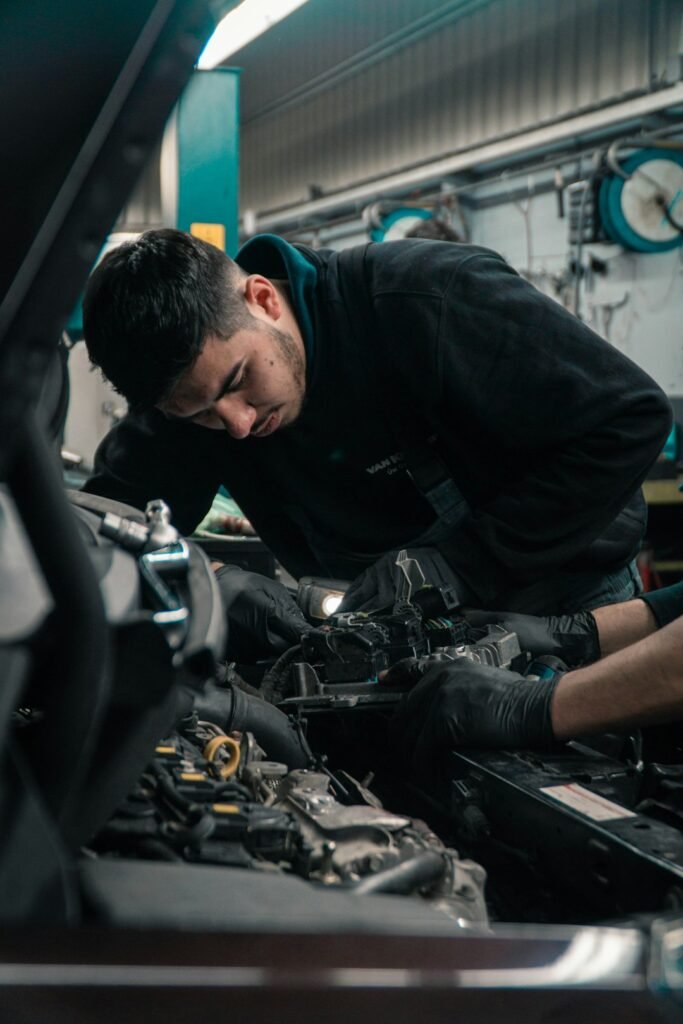
A real-world diagnostic case involving a Suzuki Swift Sport CVT
A CVT transmission can be completely rebuilt with new internal components and still develop a fault shortly afterward. One particularly confusing example is P0796 — Pressure Control Solenoid “C” Performance/Stuck Off.
Recently, a Jatco JF015E CVT case illustrated exactly why this fault should not automatically be treated as a bad solenoid or a simple TCM programming problem.
The transmission had been rebuilt with a new drive belt, new cones, new solenoids, a new hydraulic pump and a cleaned valve body. Initially, the vehicle drove normally. Later, it developed P0796, and diagnostic testing showed an important clue: hydraulic pressure was acceptable before the transmission was placed into gear, but pressure dropped when a drive or reverse range was selected. A noticeable whining noise was also present during engagement.
That combination of symptoms deserves a deeper hydraulic and mechanical diagnosis.
What Does P0796 Mean?
This is a transmission-specific example of the broader diagnostic principles covered in our automotive diagnostics guide.
P0796 is the generic OBD-II description for:
“Pressure Control Solenoid ‘C’ Performance/Stuck Off.”
The important word is “performance.”
This code does not automatically mean that Solenoid C itself is electrically defective. The transmission control module may set the code because the hydraulic response it expects does not occur, even when the solenoid coil and wiring appear electrically normal. Possible causes can include the solenoid, wiring, valve body, fluid supply, hydraulic pressure, pump operation or an internal transmission problem.
This distinction is especially important when the transmission has already received new solenoids.
The JF015E CVT and Hydraulic Pressure
The JF015E is a Jatco CVT used in a number of compact vehicles. Like other hydraulic CVT systems, it depends on controlled transmission-fluid pressure for pulley operation, ratio control and transmission engagement.
A simplified way to think about the system is:
Pump → hydraulic pressure → valve body → solenoids/control valves → hydraulic circuits → transmission application
If pressure is available but disappears when a range is selected, the diagnostic question changes.
Instead of asking only:
“Is the solenoid bad?”
the technician should ask:
“Where is the pressure going?”
That is a much more useful question.
Why Pressure Dropping When Selecting Gear Matters
One of the most important symptoms in this case is the reported pressure behavior:
Good hydraulic pressure before engagement → pressure drops when placed into gear.
That can indicate that the pump is capable of generating pressure under one condition but the hydraulic circuit cannot maintain the required pressure when the transmission applies a load.
Possible areas to investigate include:
1. Valve Body Leakage
A valve body can look clean and still have a hydraulic problem.
Wear inside a valve bore, incorrect valve movement, damaged sealing surfaces, separator-plate problems or incorrect assembly can allow hydraulic pressure to escape internally.
Even after cleaning the valve body, excessive internal leakage may remain.
A performance code such as P0796 therefore should not automatically lead to another solenoid replacement.
2. Hydraulic Pump or Suction-Side Problem
The hydraulic pump is responsible for supplying the system with CVT fluid pressure.
Because the pump was already replaced in this particular case, it would be tempting to eliminate the pump completely. That would be premature.
The technician should also verify:
- Correct pump installation
- Pump drive engagement
- Filter installation
- Suction tube and seals
- O-rings and sealing surfaces
- Correct CVT fluid level
- Possible air ingestion on the suction side
- Any restriction in the fluid supply path
A whining noise associated with engagement makes checking the fluid supply and pump operation particularly worthwhile.
3. Internal Hydraulic Leakage
If the pressure is measured with a mechanical gauge and genuinely falls when the transmission is placed into gear, an internal hydraulic leak becomes a major diagnostic consideration.
The leak could potentially be associated with:
- A valve-body circuit
- A damaged seal
- An incorrectly installed sealing ring
- A piston or apply circuit
- A separator plate or gasket
- Incorrect assembly of a hydraulic component
The exact circuit must be identified using the applicable Suzuki/Jatco service information rather than assuming which component is responsible from the generic P0796 definition.
4. Internal Wiring and Electrical Connections
Electrical diagnosis should not be ignored simply because the solenoids are new.
A replacement solenoid can still receive an incorrect command because of:
- Damaged internal transmission wiring
- Loose connector terminals
- Poor terminal tension
- Corrosion
- High resistance in the circuit
- Intermittent wiring faults
- Connector problems between the transmission and TCM
P0796 is a performance code rather than simply an open-circuit code, so the electrical circuit should be tested under the conditions in which the fault occurs.
5. Don’t Blame the TCM Too Quickly
A common suggestion when a rebuilt CVT develops a fault is:
“The TCM needs to relearn.”
CVT adaptation, calibration and relearning can certainly be important after transmission repairs, depending on the vehicle and manufacturer procedure.
However, a relearn procedure cannot repair a genuine hydraulic pressure loss.
If measured hydraulic pressure physically collapses when the transmission is commanded into gear, the technician needs to determine the reason for that pressure loss before blaming the TCM.
The correct approach is to separate the problem into two questions:
Electrical command:
Is the TCM commanding the solenoid correctly?
Hydraulic response:
Does the transmission produce and maintain the pressure expected from that command?
That distinction can save a lot of unnecessary parts replacement.
A Better Diagnostic Strategy for P0796 on a JF015E
For broader diagnostic context, see our guide to automotive diagnostics and our Nissan X-Trail CVT problems guide.
For a rebuilt JF015E showing P0796, a systematic diagnostic process is more useful than repeatedly replacing parts.
Step 1 — Confirm the exact fault
Scan the vehicle using a capable diagnostic tool and record:
- All stored and pending DTCs
- Freeze-frame data
- Transmission temperature
- Engine speed
- Input/output speed
- Commanded values
- Relevant CVT pressure data
- TCM adaptation information
Do not diagnose P0796 in isolation if other transmission codes are present.
Step 2 — Verify CVT fluid
Check the correct fluid specification and verify the level using the manufacturer’s procedure and temperature requirements.
A CVT is highly dependent on the correct fluid and hydraulic conditions.
Step 3 — Check the electrical circuit
Test the relevant solenoid circuit from the TCM/transmission connector through the internal harness.
Check continuity, resistance, power supply, grounds and connector condition.
Where possible, test the circuit while reproducing the fault rather than performing only a static resistance check.
Step 4 — Compare commanded and actual pressure
This is one of the most valuable diagnostic steps.
The technician should compare:
TCM commanded pressure vs. actual/measured pressure
If the TCM commands higher pressure but the actual pressure fails to increase or falls away, the investigation should move toward the hydraulic system.
Step 5 — Perform a mechanical pressure test
If scan data indicates a pressure problem, confirm it with an appropriate mechanical pressure test using the manufacturer’s specifications.
This can help distinguish an electronic control problem from an actual hydraulic problem.
Step 6 — Recheck the rebuild
If pressure is being lost internally, the transmission may need to be inspected again.
At that point, attention should be given to:
- Valve-body assembly
- Hydraulic passages
- Gaskets and separator plate
- Seals
- Pump installation
- Filter and suction system
- Pulley/control hydraulic circuits
- Internal components affected during the rebuild
The Most Important Lesson
The biggest lesson from this type of CVT problem is simple:
A fault code identifies a system behavior, not necessarily the failed part.
P0796 tells us that the pressure-control system is not behaving as expected. It does not, by itself, prove that the newly installed solenoid is defective.
That becomes even more important when the transmission has already had:
New solenoids + new belt + new cones + new hydraulic pump + cleaned valve body
At that point, repeatedly replacing the same type of component without confirming the hydraulic pressure behavior can become expensive guesswork.
Our Diagnostic View at MRB Auto Solution
When dealing with CVT faults, we believe the correct sequence is:
Scan → Analyze live data → Test electrical circuits → Verify hydraulic pressure → Identify the failed circuit → Repair → Calibrate/relearn → Road test
Not:
Fault code → Replace part → Clear code → Hope it works
Modern CVTs are integrated electro-hydraulic systems. A proper diagnosis needs to consider the TCM, wiring, solenoids, valve body, pump, fluid supply and internal hydraulic circuits together.
A P0796 code should therefore be treated as a diagnostic starting point—not a parts-shopping list.
Final Thoughts
In the Suzuki Swift Sport JF015E case described above, the combination of P0796, good initial pressure, pressure loss during gear engagement and a whining noise provides important diagnostic clues.
The symptoms make it reasonable to investigate the hydraulic system carefully, while still confirming the electrical command and feedback circuits before dismantling the transmission again.
The exact failed component cannot responsibly be identified from the fault code alone. Proper pressure testing, scan data and manufacturer-specific service procedures are required to reach a reliable diagnosis.
CVT diagnosis is about proving where the pressure and control are being lost—not simply replacing parts until the fault disappears.
Need CVT Diagnosis in Dhaka?
MRB Auto Solution provides automotive diagnostic and transmission-related troubleshooting services in Dhaka, including OBD/CVT diagnostics, electronic fault diagnosis, valve-body-related troubleshooting and advanced vehicle diagnostics.
For difficult CVT problems, bring the vehicle for a proper diagnostic assessment before replacing expensive transmission components.
MRB Auto Solution
European • Hybrid • Transmission Specialist
Dhaka, Bangladesh
Website: MRBAutoSolution.com.bd
Important Disclaimer
This article is intended for educational and diagnostic-awareness purposes. P0796 is a generic OBD-II fault definition and the exact diagnostic procedure, solenoid designation, pressure specifications and repair method vary by vehicle and transmission calibration. Always use the vehicle’s manufacturer service information and appropriate diagnostic equipment before performing transmission repairs.
Written by Rajib Bepari
Founder of MRB Auto Solution, with 3+ years of UAE dealership-level experience on European vehicle systems.
Leave a Reply