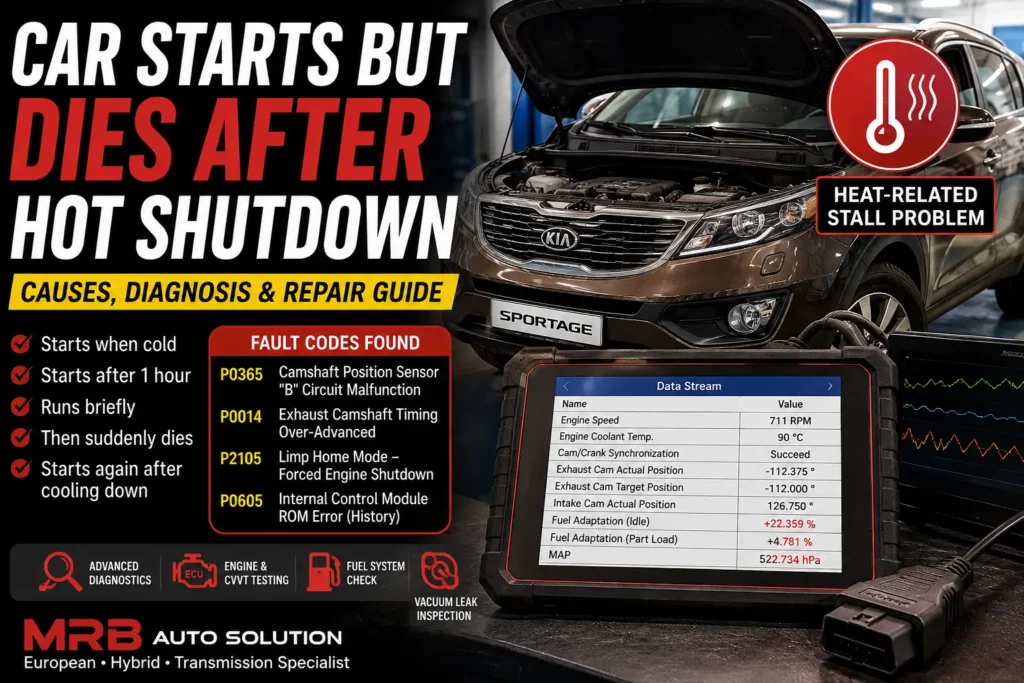
Car Starts Normally When Cold but Dies After Hot Shutdown — What Does It Mean?
One of the more frustrating automotive problems is when a car starts and runs perfectly when cold, but after driving for some time and shutting the engine off, it develops a strange problem:
- The engine starts normally when cold.
- You drive the car without major problems.
- After switching the engine off, you wait around 30–60 minutes.
- The engine starts again but runs only briefly.
- It suddenly shuts off.
- Repeated starting attempts may not solve the problem.
- After the vehicle cools down completely, the engine starts and runs normally again.
This is commonly referred to as a heat-related intermittent stalling or hot-restart problem.
The important point is that this type of fault can be difficult to diagnose because the vehicle may behave normally by the time it reaches the workshop.
A proper diagnosis therefore requires more than simply reading stored fault codes.
Why Does a Car Start and Then Die When Hot?
There isn’t one single cause.
A hot-stall condition can be caused by problems with:
- Camshaft or crankshaft position sensors
- Fuel pressure and fuel delivery
- Ignition system
- Variable valve timing (CVVT/VVT)
- Vacuum or intake air leaks
- EVAP purge system
- Throttle body
- Engine wiring and connectors
- ECU/engine control system
- Mechanical engine timing
The challenge is determining which system is actually failing at the moment the engine stalls.
A Real Diagnostic Case: 2011 Kia Sportage
A recent diagnostic case involved a 2011 Kia Sportage SL 2.0 MPI with approximately 148,465 km.
The reported symptom was:
The vehicle would start normally when cold. After driving and shutting the engine down, it could restart after approximately one hour but would not continue running and would suddenly stall. After the vehicle cooled down completely, it would start and remain running.
A diagnostic scan revealed several historical engine-related fault codes.
Important DTCs Found
P0365 — Camshaft Position Sensor “B” (Exhaust), Bank 1 Circuit Malfunction
P0014 — “B” Camshaft Position Timing Over-Advanced / System Performance
P2105 — Limp Home Mode – Forced Engine Shutdown
A P0605 — Internal Control Module ROM Error was also recorded as a historical fault.
The scan report showed these codes as History, meaning they should not automatically be treated as proof that every corresponding component is currently defective.
This distinction is extremely important when diagnosing intermittent faults.
The DataStream Revealed Something Important
A live DataStream was also captured while the engine was running.
At that time, the engine was operating around 711 RPM, with coolant temperature around 90°C and oil temperature around 87°C.
Most importantly, the scan showed:
Cam/Crank Synchronization: Succeed
The commanded and actual camshaft positions were also very close during the recorded snapshot.
This means that, at the moment the DataStream was captured, there was no obvious evidence of a permanent camshaft synchronization failure.
Therefore, immediately replacing the camshaft sensor or CVVT actuator based only on the stored DTCs would not be a proper diagnostic approach.
The DataStream itself could not be extracted as text because the supplied PDF was image-based, so its values were assessed from the report pages.
Fuel Adaptation Was Another Important Clue
One of the most interesting values in the DataStream was the fuel adaptation.
The recorded values included approximately:
Idle Fuel Adaptation: +22.36%
Part-Load Fuel Adaptation: +4.78%
A significantly higher positive fuel correction at idle deserves further investigation.
Positive fuel adaptation means the ECU is adding fuel because it is detecting a condition consistent with a lean mixture.
When the correction is substantially higher at idle than at part load, possible areas to investigate include:
- Vacuum leaks
- PCV system problems
- Intake manifold leaks
- EVAP purge valve leakage
- Intake air leaks
- Fuel delivery problems
- MAF/MAP-related issues
- Other causes of an excessively lean idle mixture
This does not prove that a vacuum leak or fuel-system problem is the root cause. It tells the technician where further testing should be concentrated.
Why Hot Restart Problems Are So Difficult to Diagnose
A heat-related fault may disappear before the vehicle reaches the workshop.
For example, a component can operate correctly at:
Cold → Normal
then become unreliable at:
High temperature → Intermittent
and finally return to normal after:
Cooling down → Normal
This is why a technician may scan the vehicle and find that everything appears normal.
The most valuable diagnostic opportunity is therefore the few seconds immediately before and during the stall.
1. Check the Camshaft Position Sensor
A camshaft position sensor can become intermittent when exposed to high engine-bay temperatures.
A sensor may produce a correct signal when cold but become unstable after reaching operating temperature.
The P0365 code makes the exhaust camshaft position circuit an important area to investigate in this particular case.
However, the correct procedure is not simply:
P0365 → Replace sensor
Instead, the technician should verify:
- Sensor power supply
- Sensor ground
- Signal voltage
- Wiring continuity
- Connector condition
- Signal waveform
- Signal stability when hot
- Cam/crank synchronization
Ideally, the signal should be monitored while reproducing the actual failure.
2. Check the Crankshaft Position Signal
The crankshaft position signal is equally important.
If the ECU loses crankshaft speed/position information, it may stop controlling fuel injection or ignition.
During the failure, monitor engine RPM while cranking.
If the scan tool suddenly shows:
RPM = 0
while the engine is physically cranking, the crankshaft position signal becomes a major suspect.
This is why live data during the failure is much more useful than a scan performed several hours later.
3. Test the CVVT/VVT System
The P0014 code indicates an exhaust camshaft timing-related condition.
Possible causes include:
- CVVT oil control valve/solenoid
- Restricted oil passage
- Incorrect engine oil condition
- CVVT actuator/phaser
- Camshaft position feedback
- Wiring problems
- Mechanical timing problems
The technician should compare:
Commanded camshaft angle vs. actual camshaft angle
and observe how quickly and accurately the camshaft responds to changes in commanded position.
A CVVT component that works correctly when cold but sticks or responds incorrectly when hot can create an intermittent problem.
4. Check for Vacuum and Intake Air Leaks
The elevated idle fuel adaptation makes an intake-system inspection worthwhile.
A small vacuum leak may have a much larger effect at idle than under higher engine load.
Common areas include:
- PCV hoses
- Intake manifold gasket
- Throttle body gasket
- Vacuum hoses
- Brake booster hose
- EVAP purge system
- Intake ducting
A smoke test can be an effective way to locate leaks that cannot be found through visual inspection alone.
5. Check Fuel Pressure When the Problem Actually Happens
Fuel pressure should not only be checked when the vehicle is operating normally.
For an intermittent hot-stall problem, compare:
Cold condition
Measure fuel pressure during normal starting and idle.
Hot condition
Measure fuel pressure after the vehicle reaches operating temperature.
Hot restart
Measure pressure immediately after shutting the engine off and during the problematic restart.
Failure condition
Observe what happens to fuel pressure immediately before the engine stalls.
Possible causes can include:
- Weak fuel pump
- Fuel-pressure regulation problem
- Fuel filter restriction
- Electrical supply problem
- Fuel delivery interruption
A fuel pressure measurement taken only after the vehicle has cooled down may completely miss the problem.
6. Don’t Ignore the Throttle Body
P2105 indicates a forced engine shutdown/limp-home condition in the stored diagnostic information.
The throttle system should therefore be evaluated as part of the overall diagnosis.
Check:
- Throttle position
- Accelerator pedal position
- Throttle command
- Actual throttle position
- Throttle body operation
- Wiring and connectors
- Related DTCs
However, P2105 alone is not enough reason to replace the throttle body.
The underlying condition that caused the ECU to enter the shutdown strategy must be identified.
7. Check Mechanical Engine Timing if Necessary
If the electronic camshaft data continues to indicate a timing problem, mechanical timing should be verified.
Potential causes include:
- Timing chain wear
- Chain tensioner problems
- Camshaft timing variation
- CVVT actuator problems
- Incorrect mechanical timing
However, if commanded and actual camshaft positions remain closely matched during the failure-free condition, mechanical timing should not automatically be blamed.
The correct approach is to confirm the fault with additional testing.
The Most Important Diagnostic Test
For this type of problem, the most valuable test is:
Capture the DataStream While the Engine Is Dying.
Do not wait until the vehicle cools down.
When the hot engine starts and begins to stall, monitor:
- Engine RPM
- Camshaft position
- Crankshaft position
- Cam/Crank synchronization
- Exhaust cam commanded position
- Exhaust cam actual position
- Intake cam commanded position
- Intake cam actual position
- MAP
- MAF, if equipped
- Fuel trims
- O2/A/F sensor data
- Injector pulse/injection time
- Fuel pressure
- Throttle position
- Ignition status
The objective is to determine what changes first.
How to Interpret the Failure
Scenario A — RPM suddenly disappears
Investigate:
Crankshaft position sensor → wiring → connector → ECU input
Scenario B — Cam/Crank synchronization changes to OFF
Investigate:
Camshaft sensor → crankshaft sensor → wiring → timing → CVVT
Scenario C — Camshaft actual position stops following target
Investigate:
CVVT/OCV → oil supply → CVVT actuator → mechanical timing
Scenario D — Fuel pressure drops
Investigate:
Fuel pump → power supply → fuel filter → pressure regulation → fuel delivery
Scenario E — Fuel trims become extremely positive
Investigate:
Vacuum leak → PCV → EVAP purge → intake system → fuel delivery → sensor inputs
Scenario F — Engine RPM, synchronization and fuel pressure remain normal
Then ignition, injector control, throttle control and ECU-related inputs require deeper investigation.
Don’t Replace Parts Based Only on Fault Codes
This is one of the most important lessons from intermittent automotive diagnostics.
A diagnostic trouble code identifies a system or condition that the ECU detected.
It does not always identify the component that must be replaced.
For example:
P0365 does not automatically mean the camshaft sensor is defective.
Likewise:
P0014 does not automatically mean the CVVT actuator must be replaced.
And:
P0605 does not automatically mean the ECU is bad, especially when the code is recorded as historical.
The correct process is:
DTC → Live Data → Reproduce Fault → Test Circuit/System → Confirm Root Cause → Repair → Verify
What Should Be Checked First on This Kia Sportage?
Based on the available diagnostic information and the reported hot-restart/stalling symptom, a logical diagnostic sequence would be:
Priority 1
Reproduce the failure while the engine is hot.
Priority 2
Monitor RPM and cam/crank synchronization during the stall.
Priority 3
Check the exhaust camshaft sensor circuit and wiring while hot.
Priority 4
Test CVVT/OCV operation and commanded vs. actual camshaft position.
Priority 5
Perform a fuel-pressure test during the actual hot failure.
Priority 6
Perform an intake/vacuum smoke test, particularly because of the elevated idle fuel adaptation.
Priority 7
If required, investigate mechanical timing and ECU-related faults.
This approach avoids unnecessary parts replacement and provides a much higher probability of identifying the actual cause.
Final Takeaway
If your car starts normally when cold but starts and dies after a hot shutdown, don’t assume that the engine itself is failing.
A heat-related intermittent fault can involve a sensor, wiring, fuel delivery, CVVT system, intake leak, ignition system or engine control strategy.
The most important diagnostic principle is simple:
Test the vehicle when the problem is actually happening.
A scan performed after the vehicle has cooled down may show stored fault codes, but it may not reveal which signal or system failed during the stall.
In the Kia Sportage case discussed here, the stored P0365, P0014 and P2105 codes provide important clues, while the live DataStream shows that cam/crank synchronization and camshaft tracking were functioning during the captured normal-running condition.
The elevated idle fuel adaptation also makes air/fuel and intake-system testing an important part of the diagnostic process.
For intermittent problems like this, professional diagnostic testing is far more reliable than replacing parts based on fault codes alone.
Need a Proper Diagnosis?
If your vehicle:
- Starts but suddenly dies
- Stalls when the engine is hot
- Won’t restart properly after driving
- Starts normally after cooling down
- Shows intermittent check-engine light
- Has camshaft, crankshaft or CVVT-related fault codes
a proper OBD diagnostic scan + live DataStream analysis can help identify the actual system causing the problem.
MRB Auto Solution provides automotive diagnostic and repair services in Dhaka, including advanced OBD diagnostics, engine diagnostics, electrical troubleshooting, European vehicle diagnostics, hybrid vehicle diagnostics and CVVT-related troubleshooting.
Don’t guess. Diagnose the root cause before replacing expensive parts.
MRB Auto Solution
European • Hybrid • Transmission Specialist
📍 Dhaka, Bangladesh
🌐 MRBAutoSolution.com.bd
📞 +880 1834-869607
Book a professional diagnostic inspection before the problem gets worse.
Written by Rajib Bepari
Founder of MRB Auto Solution, with 3+ years of UAE dealership-level experience on European vehicle systems.
Leave a Reply