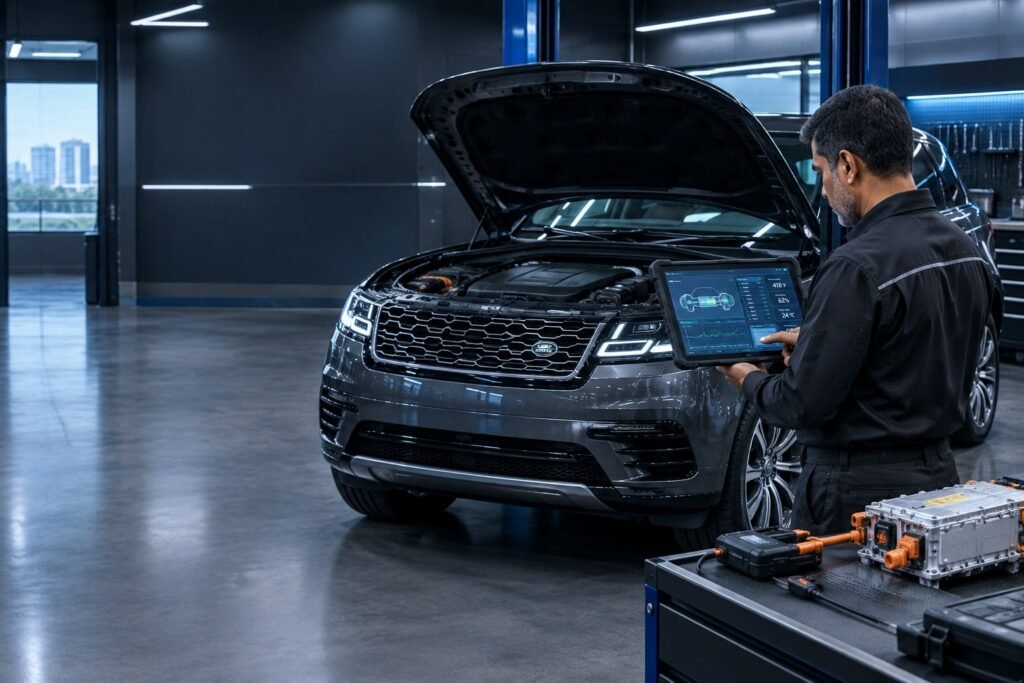
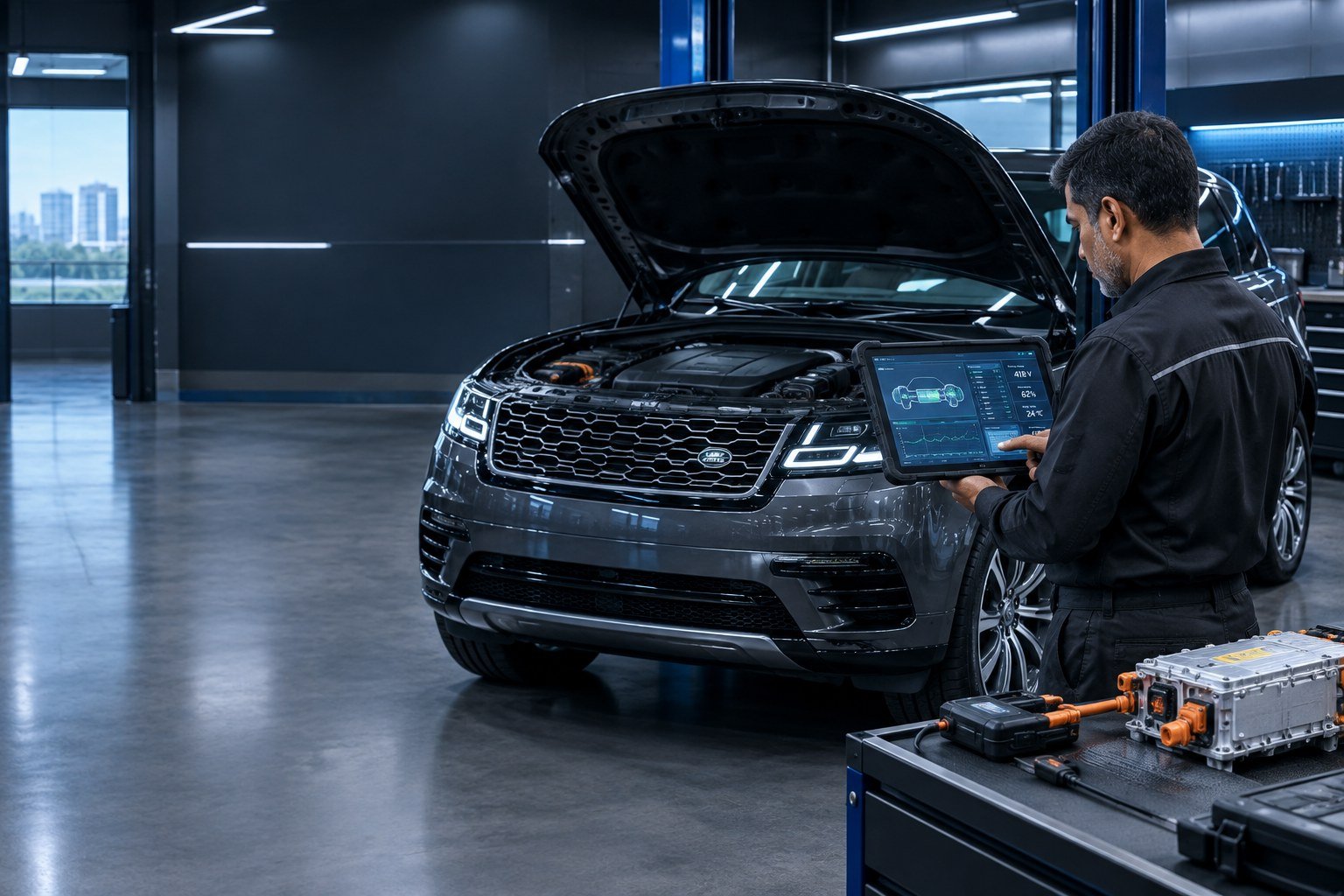
If your 2017 Range Rover 3.0L Diesel SDV6 Mild Hybrid has suddenly stopped providing electric torque assistance, displays a hybrid-system warning, delivers worse fuel economy, and appears to operate entirely on its diesel engine, the first assumption is often: “The hybrid battery is finished.”
That assumption can lead to a very expensive repair decision.
A hybrid warning does not automatically prove that the complete high-voltage battery pack has failed. Depending on the fault, the actual problem may be associated with the Battery Management Unit (BMU), high-voltage protection circuit, connectors and interlocks, or battery thermal-management system.
For a premium Land Rover, the correct approach is not simply to clear the warning or replace the most expensive component mentioned by a scan tool. The correct approach is to determine why the hybrid system entered fail-safe mode in the first place.
The Driver’s Dilemma: Hybrid Warning and Diesel-Only Operation
Owners may notice several symptoms when the hybrid system becomes unavailable:
- Hybrid warning message on the instrument cluster
- Loss of electric torque assistance
- Diesel engine operating almost continuously
- Increased fuel consumption
- Changed engine start/stop behavior
- Stored hybrid-system DTCs
- High-voltage system warnings
- Hybrid function remaining unavailable after restarting the vehicle
These symptoms can certainly occur with a serious battery fault. However, they can also occur when the vehicle’s control system detects a problem elsewhere in the hybrid architecture.
A modern hybrid system is designed to protect itself. If the control modules cannot verify that the high-voltage system is operating within safe electrical and thermal parameters, the vehicle can deliberately disable the hybrid drive function.
The result can be a Range Rover that continues driving using its diesel engine while the hybrid system remains unavailable.
Why the Hybrid System Goes Into Fail-Safe Mode
The hybrid control system continuously monitors multiple parameters, including battery voltage, cell or cell-group voltage, battery temperature, current, state of charge, communication between control modules, high-voltage circuit status, contactor/relay operation and interlock status.
If an important parameter is missing, implausible or outside the permitted operating range, the control system may prevent hybrid operation.
This is a protective strategy. The vehicle may disable the hybrid drive loop because it cannot prove that the system is safe to operate—not necessarily because every battery cell has failed.
The Real Culprits Beyond the Battery Pack
1. BMU 7.2 — Johnson Controls P/N 1266564
The Battery Management Unit (BMU) 7.2, associated with Johnson Controls P/N 1266564 in the relevant configuration, deserves particular attention during diagnosis.
The BMU forms an important part of the battery monitoring and control architecture. A BMU-related fault can potentially involve internal electronic failure, power or ground problems, communication faults, wiring problems, connector issues, or firmware/software-related problems.
If the BMU cannot communicate correctly or provide reliable information, the wider vehicle control system may prevent normal hybrid operation.
That does not automatically mean the complete battery pack must be replaced. The BMU should be diagnosed as a component within the system. Technicians should establish whether its power supply, grounds, communication lines, connector condition and reported data are consistent with expected operating conditions.
2. High-Voltage Main Fuse, Relays and Connector Interlocks
The high-voltage system contains protection devices designed to isolate the circuit when abnormal conditions are detected.
Possible failure points include high-voltage main fuse continuity, relay/contactor operation, connector pin corrosion, loose terminals, poor contact pressure, damaged wiring and connector interlock faults.
A single interruption in an important circuit can prevent the vehicle from establishing the conditions required for hybrid operation.
This is why multiple hybrid DTCs should not automatically be interpreted as multiple failed expensive components. One electrical interruption can generate several secondary communication or system-status faults.
The technician’s job is to identify the primary fault and distinguish it from codes generated as a consequence.
3. Battery Thermal Management
Electrical and thermal management are closely connected in a hybrid vehicle. The battery system must remain within its specified temperature operating range.
A thermal-management problem can therefore cause the vehicle to restrict or disable hybrid operation.
Potential causes include restricted cooling flow, blocked or damaged cooling hoses, auxiliary coolant-pump problems, cooling-fan faults, air or flow problems within the cooling circuit, temperature-sensor abnormalities and excessive battery temperature.
A vehicle that enters thermal protection should not automatically receive a replacement battery. The cooling circuit should be investigated first.
Diagnostic Accuracy Over Blind Battery Replacement
A generic OBD scan is useful for identifying where the vehicle has detected a problem, but it is not necessarily sufficient for diagnosing a complex hybrid fault. For broader context, see our guide to automotive diagnostics and why a structured diagnostic process matters.
A proper diagnostic process should combine manufacturer-level scan data, live-data analysis and physical component testing.
Depending on the system, technicians may need to evaluate:
- Individual cell or cell-group voltage
- Cell voltage delta
- Battery temperature
- Available resistance measurements
- Battery current
- State of charge
- BMU communication
- High-voltage system status
- Contactor/relay feedback
- Interlock status
- Cooling-system parameters
- Power and ground integrity
The exact parameters and test procedures depend on the vehicle configuration and diagnostic equipment available.
A diagnostic trouble code identifies a detected condition; it does not automatically identify the component that must be replaced.
For example, a communication fault involving the BMU should lead to BMU power, ground, communication and connector checks before a complete battery assembly is condemned. Similarly, a high-voltage circuit fault should trigger appropriate continuity, connection, interlock and protection-circuit testing.
Component-Level Diagnosis Can Reduce Unnecessary Replacement
For Range Rover owners in Dhaka, this diagnostic distinction can have significant financial implications.
A complete hybrid battery assembly can be a major expense. But if the root cause is actually located in a BMU, connector, fuse, interlock, wiring circuit or thermal-management component, replacing the entire battery may not address the original problem.
A structured repair process can include:
- Complete vehicle diagnostic scan
- Fault-code and freeze-frame analysis
- BMU communication verification
- High-voltage circuit inspection
- Fuse and protection-circuit testing
- Connector and wiring inspection
- Battery live-data evaluation
- Thermal-management inspection
- Component-level repair or replacement where technically justified
- Required coding/configuration/calibration
- Post-repair diagnostic verification
- Road testing under appropriate conditions
The objective is not simply to make the warning disappear. The objective is to restore the system so that the vehicle’s control modules can safely authorize normal hybrid operation.
Don’t Diagnose the Battery by the Warning Message Alone
If your Range Rover 3.0L SDV6 Mild Hybrid is showing a hybrid warning, losing electric assistance and operating primarily on its diesel engine, don’t immediately assume that the complete battery pack is defective.
The problem may be elsewhere in the hybrid architecture. BMU electronics, high-voltage protection components, connectors, interlocks and thermal-management systems all deserve proper investigation.
At MRB Auto Solution BD, our diagnostic approach focuses on identifying the root cause before recommending major component replacement.
For Range Rover and Land Rover owners in Dhaka experiencing hybrid-system warnings, diesel-only operation or abnormal fuel consumption, a proper diagnostic assessment is the appropriate first step.
MRB Auto Solution BD
European • Hybrid • Transmission Specialist
Basundhara R/A, Vatara, Dhaka
WhatsApp / Phone: +8801834869607
Website: MRBAutoSolution.com.bd
Email: mrbautosbd@gmail.com
Dealer-level diagnostic thinking. Component-level testing. Root-cause repair.
Frequently Asked Questions
Does a Range Rover hybrid warning always mean the battery needs replacement?
No. A hybrid warning can be caused by several parts of the system, including battery-management electronics, high-voltage protection circuits, connectors, interlocks and thermal-management components. The battery pack should be condemned only after appropriate testing.
Can a Range Rover operate only on the diesel engine when the hybrid system has a fault?
Yes. Depending on the detected fault and vehicle strategy, the hybrid system can be disabled as a protective measure while the vehicle continues operating using the diesel powertrain.
What is BMU 7.2 on a Range Rover hybrid system?
The Battery Management Unit is an electronic control component involved in monitoring and managing the high-voltage battery system. The relevant configuration discussed in this article is associated with Johnson Controls P/N 1266564.
What should be checked before replacing a Range Rover hybrid battery?
A diagnostic assessment should consider the BMU, power and grounds, communication circuits, high-voltage protection components, fuses, connectors, interlocks, battery data and thermal-management system before condemning the complete battery pack.
Can a high-voltage fuse or connector cause a hybrid warning?
Yes. An interruption in an important high-voltage circuit or an interlock/connection problem can prevent the vehicle from establishing the conditions required for hybrid operation.
Why does my Range Rover get worse fuel economy when the hybrid system is disabled?
When electric torque assistance and other hybrid functions are unavailable, the diesel engine may perform more of the vehicle’s propulsion work. The resulting change in operating strategy can increase fuel consumption.
Can clearing the hybrid fault codes fix the problem?
Clearing codes does not repair the underlying fault. If the control module detects the same abnormal condition again, the warning and fail-safe state may return.
Where can I diagnose a Range Rover hybrid system in Dhaka?
MRB Auto Solution BD provides automotive diagnostic and hybrid-system services in Basundhara R/A, Vatara, Dhaka. Contact +8801834869607 before visiting to discuss the vehicle and diagnostic requirements.
Written by Rajib Bepari
Founder of MRB Auto Solution, with 3+ years of UAE dealership-level experience on European vehicle systems.
Leave a Reply